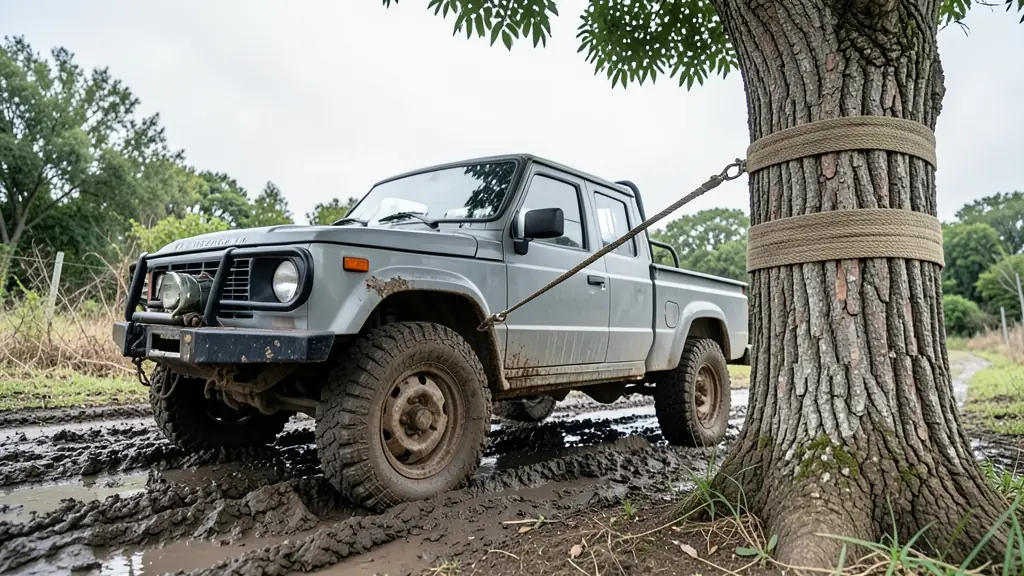
Recovery gear that is too weak breaks, and a broken strap or cable flies with enough force to kill. Gear that is far too strong does not stretch the way a snatch strap should. These are the sizing rules most 4x4 trainers and suppliers use, worked out for your vehicle, plus a rough estimate of how hard the ground is holding it.
How the sizes are worked out
- Winch: a rated line pull of at least 1.5 times the vehicle's loaded mass, rounded up to the next 500 lb (winches are sold in pounds).
- Snatch strap or kinetic rope: a minimum breaking strength of 2 to 3 times the stuck vehicle's mass. The calculator picks the smallest common size at 2 times or more.
- Shackles: rated bow shackles or soft shackles with a working load limit at least the vehicle's mass.
- Pull needed: the vehicle's mass times a rough resistance for the ground (about 5% rolling on firm ground up to about 65% in deep mud), plus the slope. It is a rule of thumb to show why mud and hills need a snatch block, not a measurement.
Safe recovery, every time
- Use rated recovery points bolted to the chassis. Never a tow ball, a tie-down hook or a bumper: tow balls snap off and fly.
- Keep everyone well clear, at least one and a half times the length of the strap or cable, and never step over a loaded line.
- Drape a damper or a heavy jacket over a winch cable or strap mid-way.
- Use a tree trunk protector around trees, low on the trunk.
- If it will not come out with your own gear, call a recovery operator rather than pulling harder. Gear guides: winches and tow ropes and straps.
Frequently asked questions
What size winch do I need for a double cab bakkie?
Take the bakkie's loaded mass, often 2,800 to 3,200 kg with gear, and multiply by 1.5. That points to a winch of about 9,500 to 12,000 lb, which is why those sizes are the most common on bakkies in South Africa.
What is the difference between a snatch strap and a tow strap?
A snatch strap stretches and stores energy, so it can pull a stuck vehicle out with a run-up. A tow strap barely stretches and is for steady towing on a road. Never use a tow strap for snatching or a snatch strap for towing on a road.
Can I tow a broken-down car with a strap?
On a public road a rope, chain or strap may be at most 3.5 m long between the vehicles, and you may not go faster than 30 km/h unless the vehicles are joined by a tow bar or drawbar. The towed car needs a licensed driver steering it. For anything but a short pull, call a tow truck.