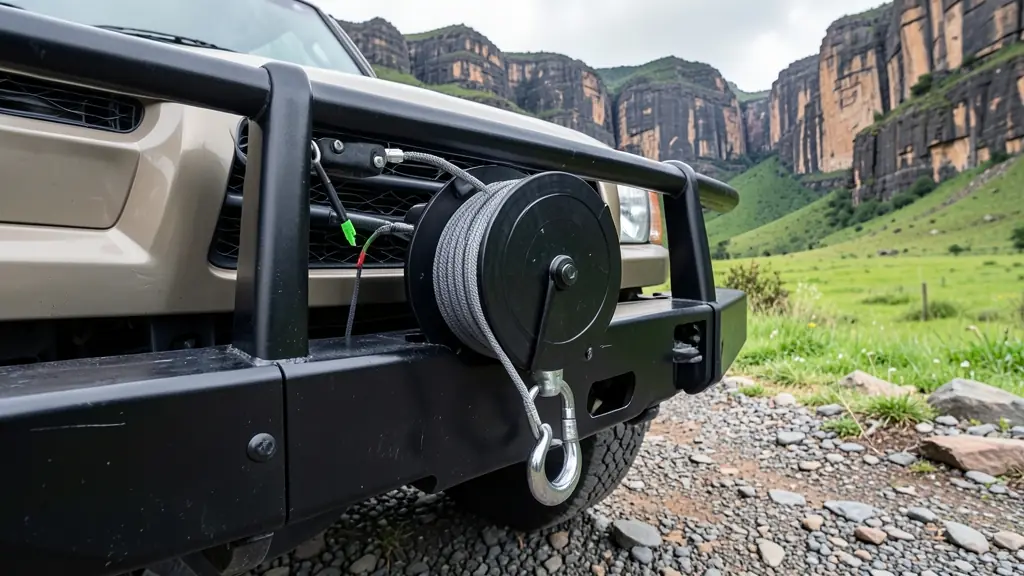
A winch turns a stuck vehicle into a recoverable one, and on a car trailer it lets one person load a non-runner. The rating has to suit the vehicle's mass, the mount has to take the full pull, and the battery and wiring have to feed a motor that draws heavy current. Choosing rope, fairlead and controls is as important as the winch itself. Tell us your vehicle and how you will use it, and suppliers and fitment centres near you will send free, no-obligation winch quotes.
Sizing the line pull
A common rule is a rated line pull of at least one and a half times the vehicle's gross mass. A loaded double-cab bakkie often needs a 9,500 to 12,000 lb winch. The rating applies on the first layer of rope on the drum: pull drops with every layer, so a long pull with little rope out is weaker. Mud and steep slopes add load. Use a snatch block to double the pull and halve the speed.
Synthetic rope or steel cable
- Synthetic rope is lighter, floats, does not kink and stores less energy if it snaps. It needs a smooth alloy hawse fairlead and a sleeve where it rubs.
- Steel cable resists abrasion on rocks and costs less, but frays into sharp wires and whips hard if it breaks. It uses a roller fairlead. Always lay a damper or heavy blanket over the line.
Keep at least five wraps on the drum, and spool the line back under tension so it does not bury itself.
Battery, wiring and mounting
A big electric winch draws very high current under load. Run the engine while winching, use the thick cables supplied, and fuse or isolate the main feed. Many 4x4 owners fit a dual battery system. The winch must sit on a rated bull bar or a mounting plate bolted to the chassis, never only to a bumper. A trailer winch needs its own battery or a heavy feed from the tow vehicle.
Price and quotes
A 9,500 to 12,000 lb electric winch is about R10,400 to R14,500. The bull bar, mount, rope upgrade and fitting are extra. For recovery kit, see tow ropes and recovery straps, and for being pulled out by a pro, vehicle recovery.
What to include in your request
- Vehicle and its loaded mass
- Use: 4x4 recovery or trailer loading
- Synthetic rope or steel cable
- Bull bar or mount needed
- Supply only or fitted with wiring
Winches for different clients
- Motorists and families: a winch on the family 4x4 for self-recovery on holiday tracks
- Company fleets and rental firms: winches on fleet 4x4s that work on rural routes and service roads
- Truckers, buses and logistics: a winch on a support truck to pull stuck trailers back onto firm ground
- Farmers and 4x4 owners: a winch on a farm bakkie for mud, river crossings and fence work
- Dealers, panel beaters and workshops: a trailer winch that loads non-running cars at auctions and panel shops
- Construction, mining and plant hire: winches on site vehicles for recovery on wet construction and mine roads
- Caravan, boat and bike owners: a winch for overlanding, beach launches and pulling boats up a slipway
- Municipalities, estates and schools: winches on municipal and parks vehicles that work on gravel and bush tracks
Frequently asked questions
What size winch do I need for my bakkie?
How much does an electric winch cost?
Is synthetic winch rope safer than steel cable?
Can you fit a winch for me?
Winches by province and city
- Johannesburg
- Pretoria
- Centurion
- Midrand
- Sandton
- Randburg
- Roodepoort
- Krugersdorp
- Randfontein
- Germiston
- Boksburg
- Benoni
- Kempton Park
- Alberton
- Vanderbijlpark
- Vereeniging
- Durban
- Pinetown
- Pietermaritzburg
- Richards Bay
- Newcastle
- Ladysmith
- Gqeberha (Port Elizabeth)
- East London
- Kariega (Uitenhage)
- Mthatha
- Cape Town
- Bellville
- Paarl
- Stellenbosch
- George
- Worcester
- eMalahleni (Witbank)
- Middelburg
- Secunda
- Mbombela (Nelspruit)
- Rustenburg
- Brits
- Klerksdorp
- Potchefstroom
- Mahikeng
- Polokwane
- Tzaneen
- Kimberley
- Upington
- Bloemfontein
- Welkom
- Sasolburg